On Sunday, July 11th, nineteen members of Huan's family came out to the site for an official dedication of the Huan Tran Telescope at the James Ax Observatory. In their presence, we installed a plaque commemorating the project's namesake scientists.
Tuesday, July 20, 2010
HTT at JAO dedication
On Sunday, July 11th, nineteen members of Huan's family came out to the site for an official dedication of the Huan Tran Telescope at the James Ax Observatory. In their presence, we installed a plaque commemorating the project's namesake scientists.
Thursday, June 10, 2010
Unwelcome Visitor
Wednesday, May 26, 2010
Observations
Things are winding down in the field a bit - tomorrow we'll be briefly down to 5 people for a few hours between Aubra leaving and Hans arriving. The receiver, telescope and readout are behaving well enough now to keep things running with only a few people. We've already achieved many of the instrument demonstrating astronomical observations we planned to in California, including:
- Jupiter - the brightest point source in the sky at 150GHz, for mapping our beams and calibrating throughput
- Tau A, the crab nebula - A bright polarized source in the sky, for demonstrating and calibrating polarization sensitivity. Humans saw the supernova progenitor 1000 years ago.
- The Galaxy - We're observing this one the same way we'll observe the cosmic microwave background, but it's much brighter, so it has a fast turnaround time and acts as a dry run for science.
- Saturn, Mars, 3C279, J1229+0203, etc - An assortment of sources across the sky, planets and the brighter quasars, whose positions have been measured to exquisite precision using optical telescopes and interferometer arrays like CARMA. We measure where they appear to be in our telescope, and check that against where we know they actually are.
Friday, May 21, 2010
Hair cut
Tuesday, April 27, 2010
Automated operation
The Polarbear receiver with operating bolometers ran continuously as the HTT scanned the sky all night last night. We all left it to get some sleep, but as of dawn, all systems appear to be working. As you can see from the dawn photograph, the weather was imperfect by morning. We'll have to look at the data to see how opaque the atmosphere was during the night. Jupiter will rise above an elevation angle of 20 degrees in 5 minutes, and the telescope will start observing it as soon as it does
Sunday, April 18, 2010
Days 12-16, Cooldown
The aftermath of assembling and
installing the receiver. Where's the broom?
Ian arrived along with Nate from UCSD
Chase and his stylish hat
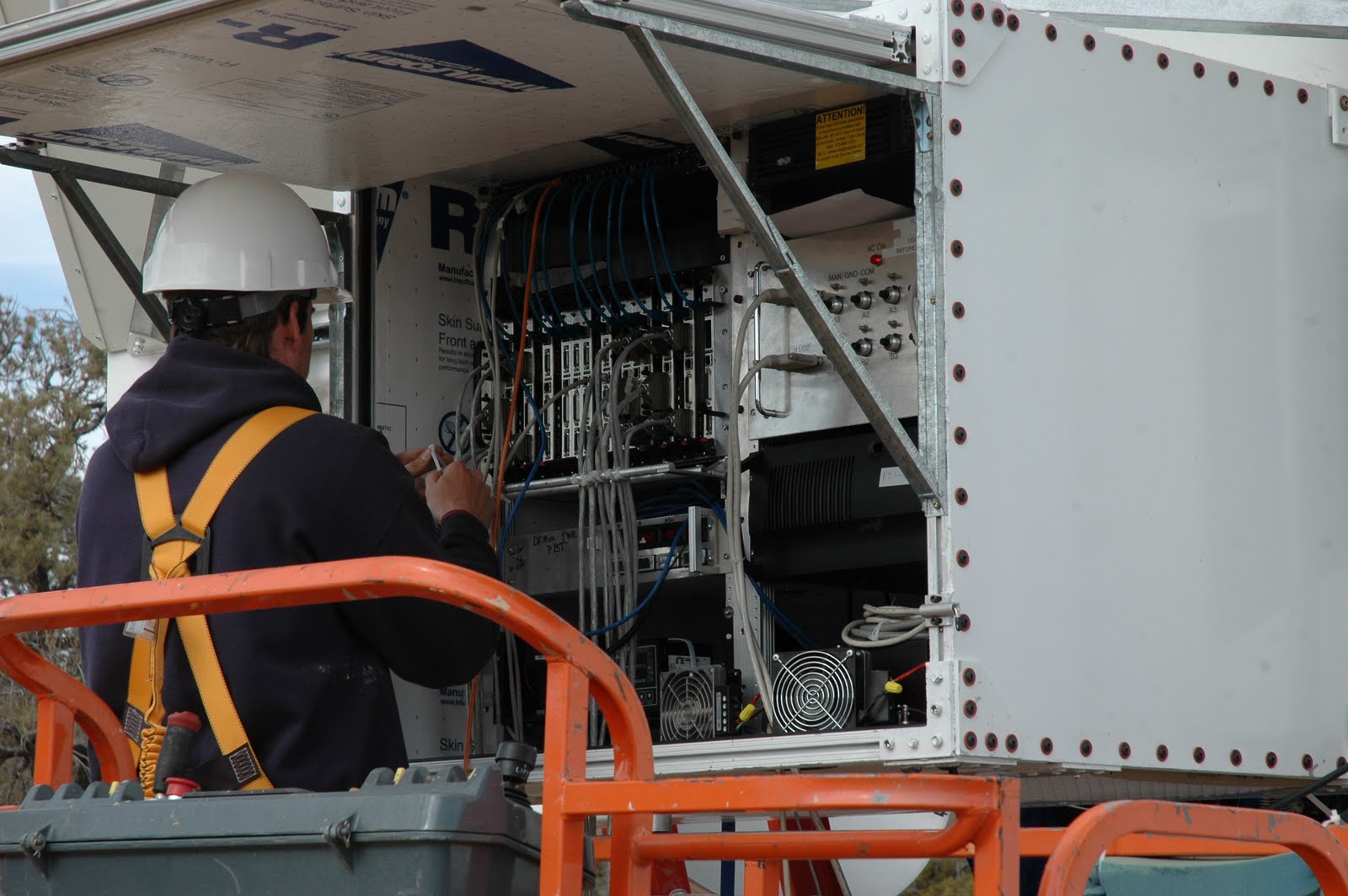
Peter and Marius finished weatherproofing the electronics crate.
Dave and Adrian preparing for optics alignment measurements
from inside the telescope.
Measuring the position of the primary mirror
Subscribe to:
Posts (Atom)